- +255 22 212 7593
- info@cutchi.or.tz

About us

History and Origin
Short history of the origins of us Cutchi people in Tanzania. People from the Island of Cutch and the Rann of Cutch (desert north west of India, bordering Sindh now a province in Pakistan), started visiting the coast of East Africa more than 2000 years ago. They settled from Mogadishu in the north to Maputo in the South, cooperating with Persians and Arabs. After the year 711 when Sheikh Muhammad bin Cassim introduced Islam in Sindh and Cutch, a majority of people living there converted to Islam. When the first Europeans from Portugal arrived in East Africa in 1498, they found several Muslim Indian settlements here, especially from Cutch, and the ports of Kalikat and Kochin in South India. With the establishment of the Zanzibar-Oman Sultanate in 1839, Sayyid Said bin Sultan Al-Busaidi invited Cutchis to Zanzibar to finance the caravan trade upcountry up to the Congo, develop overseas trade to the Middle East and South Asia, modernize and administer the ports and build stone towns.
When East Africa was colonized and divided by the Europeans in 1890, and Zanzibar became a British Protectorate, there were about 9000 Zanzibaris of Cutchi and Sindhi origin, almost all of them Muslim. The few non-Muslim Cutchis were Wania, Bhatia and Leva Patel. The Muslim Cutchis were Sunni Hanafi, Ithna’asheri, Ismaili and a few Bohoras. The Sunni Hanafi Cutchis were the largest group, also spread all along the Coast and inland towns of Tanganyika (Tanzania Mainland).
The British divide-and-rule policy encouraged the various groups of Indians in East Africa to form their own “Communities” based on religion, denomination (Madh’hab), language and place of origin. In 1904, the Cutchi Sunni Jamaat was formed in Zanzibar, and by 1912 it had branches in Dar es Salaam, Tanga, Tabora, Kigoma and Mombasa. In 1942 the Sunni Madressa (for Sunni Cutchi Girls, today’s Sunni Madressa School) was founded in Zanzibar, while the Sunni Cutchi boys continued to attend the integrated government and private schools. Thus Zanzibar was a stepping stone for hundreds of families coming to East Africa from Cutch which was an independent State until 1924 when it was forced into British India. Prior to that Cutch had its own passport, currency and army in which many soldiers were Sidis (Cutchi’s of Black African Origin from Tanzania and Kenya).
As you all know, today, Cutch is a District in the Indian State of Gujarat. It is the largest district forming 20% of the land area of Gujarat. Cutch has a population of 3 million people, with Hindu and Jain majority, while the rest of Gujarat has 50 million people (also with a large Hindu and Jain majority). Cutchi is a “boli” (dialect) of Sindhi which is the “bhasha” (language), and Cutchi has more than a dozen sub-dialects spoken by different communities in India, Pakistan, Eastern Africa, Europe and North America.
When East Africa was colonized and divided by the Europeans in 1890, and Zanzibar became a British Protectorate, there were about 9000 Zanzibaris of Cutchi and Sindhi origin, almost all of them Muslim. The few non-Muslim Cutchis were Wania, Bhatia and Leva Patel. The Muslim Cutchis were Sunni Hanafi, Ithna’asheri, Ismaili and a few Bohoras. The Sunni Hanafi Cutchis were the largest group, also spread all along the Coast and inland towns of Tanganyika (Tanzania Mainland).
The British divide-and-rule policy encouraged the various groups of Indians in East Africa to form their own “Communities” based on religion, denomination (Madh’hab), language and place of origin. In 1904, the Cutchi Sunni Jamaat was formed in Zanzibar, and by 1912 it had branches in Dar es Salaam, Tanga, Tabora, Kigoma and Mombasa. In 1942 the Sunni Madressa (for Sunni Cutchi Girls, today’s Sunni Madressa School) was founded in Zanzibar, while the Sunni Cutchi boys continued to attend the integrated government and private schools. Thus Zanzibar was a stepping stone for hundreds of families coming to East Africa from Cutch which was an independent State until 1924 when it was forced into British India. Prior to that Cutch had its own passport, currency and army in which many soldiers were Sidis (Cutchi’s of Black African Origin from Tanzania and Kenya).
As you all know, today, Cutch is a District in the Indian State of Gujarat. It is the largest district forming 20% of the land area of Gujarat. Cutch has a population of 3 million people, with Hindu and Jain majority, while the rest of Gujarat has 50 million people (also with a large Hindu and Jain majority). Cutchi is a “boli” (dialect) of Sindhi which is the “bhasha” (language), and Cutchi has more than a dozen sub-dialects spoken by different communities in India, Pakistan, Eastern Africa, Europe and North America.
Mwalimu Julius K. Nyerere
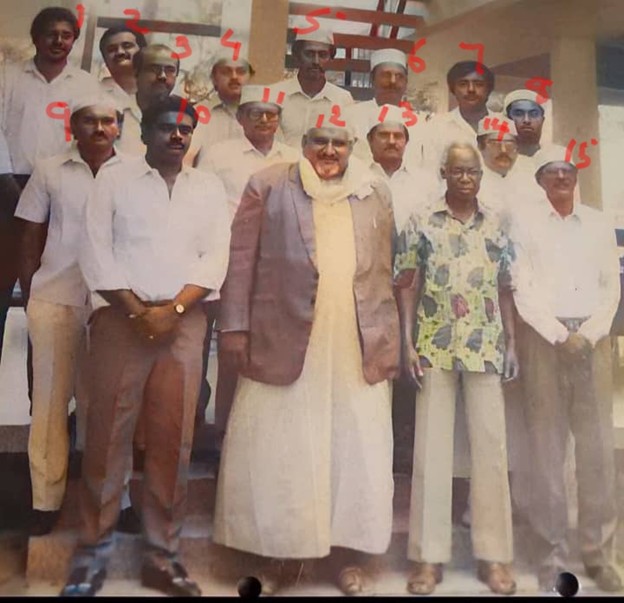
A cordial visit to the residence of our first late president, Mwalimu Julius Nyerere in the early 1990s.
Members in the picture by annotated number
- 01. NOORMOHAMAD KHATRI
- 02. YAKUB EBRAHIM
- 03. NAZIR AHMED
- 04. ABDUL MADINA
- 05. HUSSEIN ESMAIL
- 06. WAZIR LODHI
- 07. YUSUF ESMAIL
- 08. MOHAMMED KHATRI
- 09. RAFIQ ESMAIL
- 10. AKBAR SUMAR
- 11. YUSUF SAMAA
- 12. ABDULMAJID SALEH(cm)
- 13. ESMAIL PISSU
- 14. FAKIRMOHAMED GARANA
- 15. KHAMISA
Members in the picture by annotated number
- 01. NOORMOHAMAD KHATRI
- 02. YAKUB EBRAHIM
- 03. NAZIR AHMED
- 04. ABDUL MADINA
- 05. HUSSEIN ESMAIL
- 06. WAZIR LODHI
- 07. YUSUF ESMAIL
- 08. MOHAMMED KHATRI
- 09. RAFIQ ESMAIL
- 10. AKBAR SUMAR
- 11. YUSUF SAMAA
- 12. ABDULMAJID SALEH(cm)
- 13. ESMAIL PISSU
- 14. FAKIRMOHAMED GARANA
- 15. KHAMISA